



The legal industry is undergoing a major digital shift. In 2026, law firms operate in an increasingly competitive legal landscape where visibility on Google directly influences client trust, case volume, and long-term growth. Traditional referral-only models are no longer enough. Today, SEO for law firms is the foundation of online discoverability, authority building, and sustainable client acquisition.
With Google algorithm updates in 2026, AI-powered search results, predictive ranking systems, and machine-learning algorithms now shaping search outcomes, law firms must adopt modern law firm digital marketing strategies to remain relevant. Search engine optimization for lawyers ensures your firm is found by prospective legal clients at the exact moment they are searching for legal help.
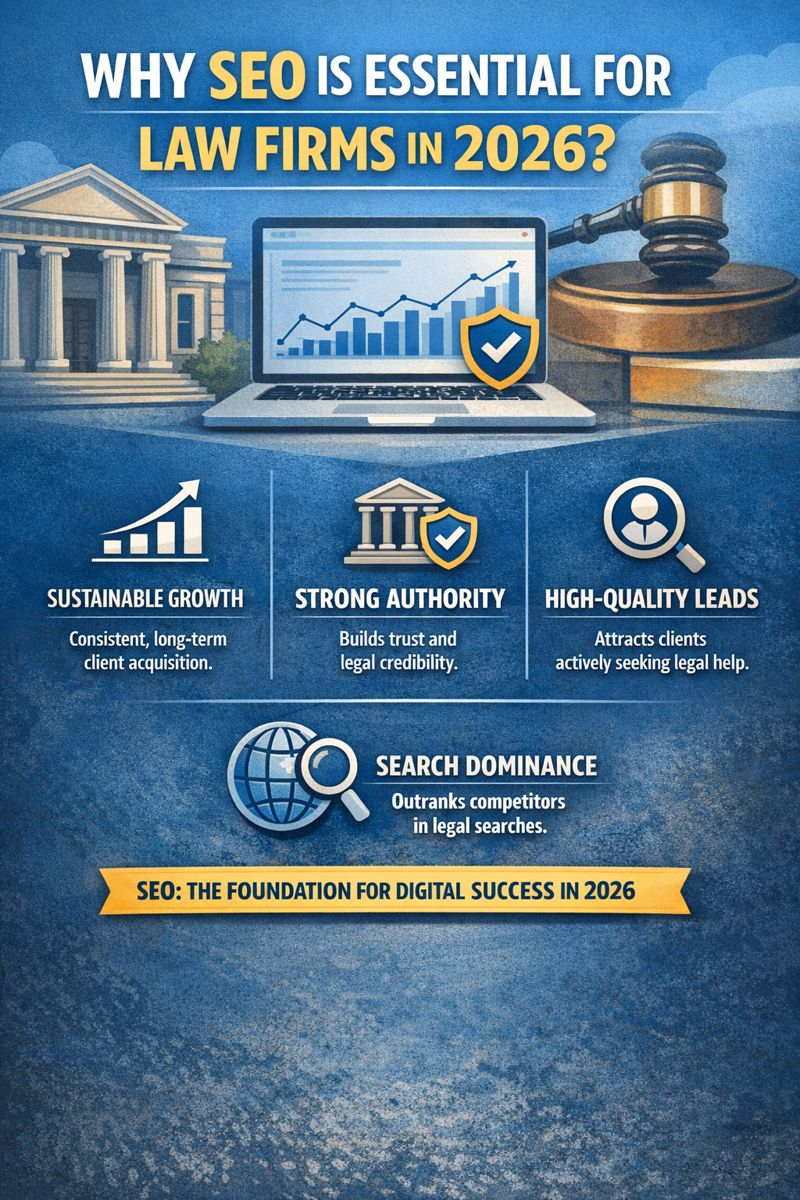
How People Find Lawyers in 2026?
In 2026, most people will find lawyers online rather than through traditional referrals. Prospective clients rely heavily on Google searches, local listings, and online reviews to compare legal service providers before making contact. Search visibility, trust signals, and local relevance now play a critical role in how law firms attract new clients.
“Near Me” and Local Searches Dominate
In 2026, legal searches are overwhelmingly local. Queries like “personal injury lawyer near me” or “criminal defense attorney in [city]” dominate search behavior. These searches rely on local SEO for attorneys, proximity-based discovery, and strong geographic relevance.
Law firms that implement local SEO for law firms benefit from higher visibility in map results, stronger community presence, and increased case-related inquiries driven by local search intent and area-specific demand.
More Clients Trust Google Than Referrals Alone
While referrals still matter, Google now plays a central role in the client intake process. Prospective legal clients evaluate firms based on reviews, website quality, content accuracy, and trust signals. Strong law firm branding online, combined with informational transparency and professional authenticity, builds attorney-client trust before the first consultation.
What Is Law Firm SEO?
Law firm SEO is the process of optimizing a legal website to improve online visibility for lawyers through organic search. This includes technical SEO, content optimization, link building, local SEO, and authority signals. Effective SEO for lawyers helps Google understand topic depth, practice-area competition, and jurisdiction-based marketing relevance.
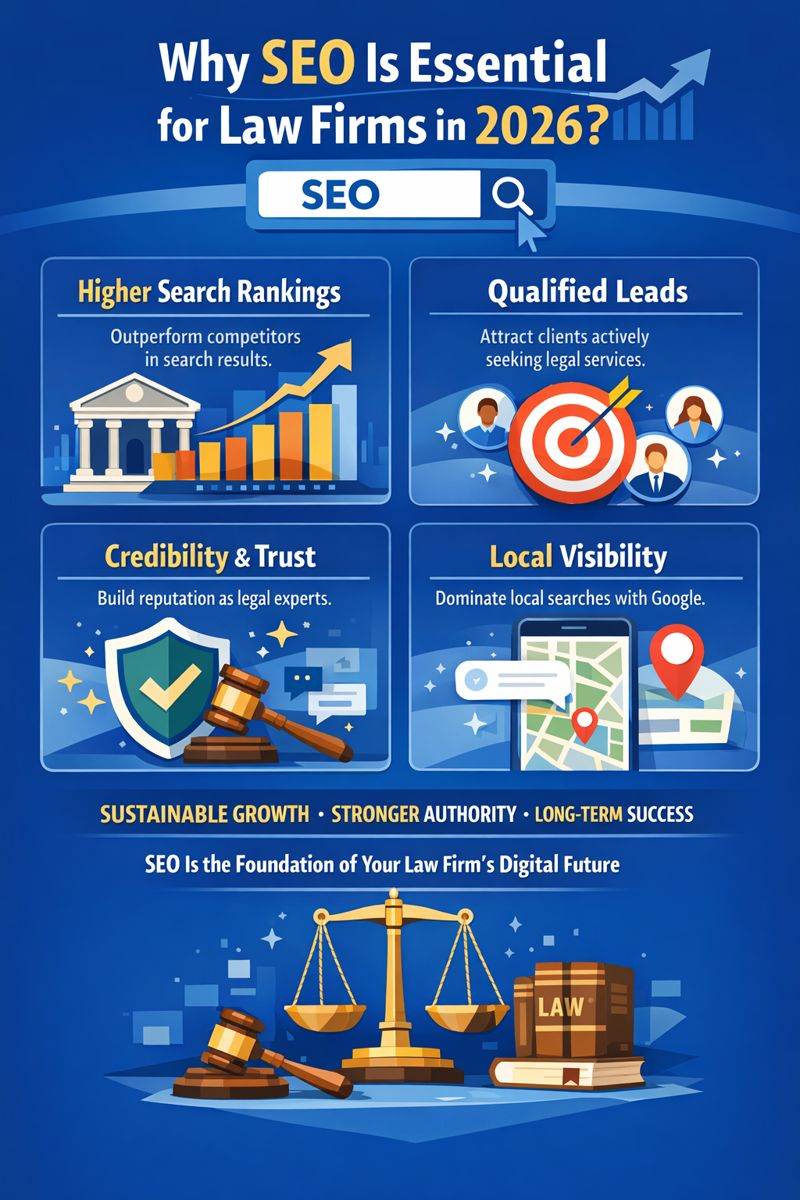
SEO vs PPC for Law Firms
PPC delivers immediate visibility but stops when ad spend ends. SEO, on the other hand, creates long-term digital assets that drive consistent organic traffic for lawyers. In 2026, SEO marketing for lawyers offers better marketing ROI stability, cost-efficient growth, and sustainable lead flow compared to paid ads alone.
SEO vs PPC for Law Firms (2026)
| Factor | SEO for Law Firms | PPC for Law Firms |
|---|---|---|
| Cost Structure | Long-term investment with ongoing optimization costs | Pay-per-click; costs increase with competition |
| Time to Results | Takes time to build rankings and authority | Immediate visibility and traffic |
| Lead Quality | Higher-intent, research-driven leads | Can attract mixed-quality leads |
| Sustainability | Generates consistent traffic over time | Traffic stops when ad budget ends |
| ROI Over Time | Strong long-term ROI and cost efficiency | Short-term ROI, higher long-term costs |
| Trust & Credibility | Builds authority and trust organically | Ads may be viewed as less trustworthy |
| Competitive Advantage | Strengthens long-term market position | Easy for competitors to outbid you |
| Best Use Case | Long-term growth and brand authority | Immediate lead generation and promotions |
Key Benefits of SEO for Law Firms in 2026
In 2026, SEO plays a critical role in helping law firms stay visible, competitive, and trusted online. A strong SEO strategy not only improves search rankings but also drives qualified leads, builds credibility, and supports long-term growth in an increasingly digital legal marketplace.
- Higher Quality Leads- SEO attracts users with clear legal intent. These visitors are actively searching for legal solutions, resulting in better inquiry quality improvement and higher conversion pathways across client acquisition channels.
- Build Trust and Authority Online- Strong SEO supports EEAT for legal websites by emphasizing experience-backed insights, fact-based content, and professional responsibility. Authority building strengthens trust reinforcement and client confidence.
- Better ROI Than Paid Advertising Over Time- SEO delivers measurable performance and a visibility compounding effect. As rankings improve, lead volume grows without increasing advertising costs making SEO essential for law practice growth.
Google’s 2026 Ranking Factors That Matter for Lawyers
Google’s ranking system in 2026 is more advanced, AI-driven, and user-focused than ever before. For lawyers, rankings now depend on trust, content quality, local relevance, and user experience, not just keywords. Understanding the keyword research is important for the success of SEO helps you create content that truly matches what users are searching for, improves search engine visibility, and attracts a more relevant audience resulting in higher rankings and consistent, high-quality organic traffic over time. Understanding these factors is essential for maintaining visibility and attracting high-intent legal clients.
- Local SEO & Google Business Profile Optimization- Local SEO for attorneys remains a top ranking factor. Accurate listings, reviews, and localized content improve geographic relevance and regional competition visibility.
- EEAT for Legal Content- Google prioritizes informational accuracy, ethical promotion, compliance-friendly marketing, and experience-backed insights especially for legal service providers.
- Helpful, Practice-Area Content Wins- Content that answers real legal questions improves content clarity and search intent modeling. This helps Google match your pages to high-intent searches.
- Mobile Speed and User Experience- Mobile usability, accessibility standards, behavioral signals, and engagement metrics directly influence Google ranking for law firms.
- Most Important SEO Strategies for Law Firms in 2026
To remain competitive and visible in 2026, law firms need SEO strategies that align with AI-driven search, user intent, and local relevance. Many of these proven methods are covered in the techniques to build strong online presence for law firms which emphasize building authority, trust, and sustainable long-term performance instead of relying on short-term ranking tactics. Key SEO strategies law firms should prioritize include:
- Local service pages by city and practice area to capture high-intent, location-based searches
- Legal content marketing that answers real client questions and demonstrates topic depth
- On-page SEO optimization for practice pages, including clear structure, internal linking, and keyword alignment
- Google Business Profile optimization to strengthen local SEO and map visibility
- EEAT-focused content that highlights experience, credentials, and factual accuracy
- Mobile speed and user experience improvements to meet accessibility and usability standards
- High-quality link building to boost legal authority and trust signals
- Voice search and featured snippet optimization to align with conversational and AI-powered search behavior
Together, these strategies help law firms achieve sustainable rankings, higher-quality leads, and long-term digital growth in an evolving legal search landscape.
Common SEO Mistakes Law Firms Must Avoid
Many law firms lose rankings and leads by relying on outdated or incomplete SEO tactics. Common mistakes include ignoring local SEO optimization, publishing thin or generic content, neglecting mobile usability, and failing to build trust through accurate, compliant legal information. Avoiding these errors is essential to maintaining visibility and credibility in competitive legal search results.
- Ignoring local SEO tips for law firms in 2026
- Publishing AI content without legal oversight
- Weak mobile usability or accessibility gaps
- Keyword stuffing instead of topic depth
- No strategy for zero-click searches for lawyers
How to Measure SEO Success for a Law Firm
Many law firms lose rankings and leads by relying on outdated or incomplete SEO tactics. Common mistakes include ignoring local SEO, publishing thin or generic content, neglecting mobile usability, and failing to build trust through accurate, compliant legal information. Avoiding these errors is essential to maintaining visibility and credibility in competitive legal search results. SEO success should be measured using:
- Organic traffic growth
- Law firm lead generation metrics
- Engagement metrics and behavioral signals
- Conversion tracking within the client intake process
- Long-term positioning and visibility growth
Should Law Firms Invest in SEO or PPC in 2026?
In 2026, law firms should not view SEO and PPC as competing strategies, but as complementary ones. SEO provides long-term visibility, builds trust, and generates consistent organic leads, while PPC delivers immediate exposure and short-term case opportunities. Firms that rely only on PPC risk rising costs and unstable lead flow, whereas SEO creates lasting digital assets that continue to perform over time.
For the strongest results, the best approach is a balanced investment in both Search Engine Optimization (SEO) and Pay-Per-Click (PPC) using SEO to support sustainable growth and authority, and PPC to capture high-intent searches and fill short-term gaps in lead generation.
Best Approach: SEO and PPC Together
Using SEO and PPC together allows law firms to balance short-term results with long-term growth. PPC helps capture immediate, high-intent searches and generate leads quickly, especially for competitive practice areas. This makes it ideal for filling gaps while SEO efforts are building momentum.
At the same time, SEO strengthens organic visibility, trust, and authority over time. As rankings improve, law firms benefit from consistent traffic without rising ad costs. When combined, SEO and PPC create a stable, cost-efficient marketing strategy that delivers reliable leads and supports sustainable growth.
Why Hiring a Legal SEO Agency Helps
Hiring a legal SEO agency helps law firms navigate complex search algorithms, competitive markets, and strict compliance requirements more effectively. Experienced agencies use data-driven strategies, legal-specific SEO expertise, and ongoing optimization to improve visibility, attract qualified leads, and support long-term growth. Professional SEO services for law firms provide:
- AI-driven SEO for law firms
- Law firm SEO automation
- Data-led marketing decisions
- Predictive ranking systems
- User journey optimization
With expert guidance, law firms can adapt to the future of SEO for law firms, maintain market relevance, and build a scalable digital presence.
Schedule a SEO consultation today
In 2026, SEO is no longer just a marketing tactic, it is the digital infrastructure that supports a law firm’s visibility and growth. Firms that invest in hiring the best SEO company in Philadelphia will help build lasting authority, attract consistent high-quality leads, and position themselves for long-term success in an increasingly competitive search landscape. Contact us by calling 215-826-3437 to schedule a consultation with our SEO Process USA team.
Frequently Asked Questions (FAQs)
Why is SEO important for law firms in 2026?
SEO is essential for law firms in 2026 because most clients search for legal services online. Strong SEO improves visibility, builds trust, and helps firms attract qualified leads in an increasingly competitive digital legal market.
How does SEO help law firms get more clients?
SEO helps law firms appear in Google search results when potential clients are actively looking for legal help, leading to higher-quality leads and a more consistent client intake process.
Is SEO better than PPC for law firms in 2026?
SEO is more effective for long-term growth, while PPC delivers short-term results. In 2026, SEO provides sustainable traffic and authority, whereas PPC stops generating leads once ad spending ends.
What type of SEO is most important for law firms?
Local SEO is the most important, including city-based service pages, Google Business Profile optimization, and location-focused content to capture “near me” legal searches.
How long does SEO take to work for a law firm?
SEO typically takes three to six months to show noticeable results, but it delivers long-term benefits that continue to grow over time without increasing costs.
Does SEO help build trust for law firms?
Yes, SEO improves credibility by showcasing expertise, accurate legal content, reviews, and strong website signals that build client confidence before the first consultation.
Are Google rankings more competitive for lawyers in 2026?
Yes, competition is higher due to AI-driven search results and more firms investing in SEO, making professional optimization essential to stay visible.
Can small law firms benefit from SEO in 2026?
Yes, SEO allows small and mid-sized law firms to compete locally by targeting specific practice areas, locations, and high-intent legal searches.
What happens if a law firm ignores SEO in 2026?
Law firms that ignore SEO risk losing online visibility, falling behind competitors, and missing out on high-quality clients who rely on search engines to find legal services.
Do law firms need an SEO agency in 2026?
Hiring a legal SEO agency helps law firms adapt to algorithm changes, stay compliant, and implement advanced strategies that drive measurable, long-term results.